

Ingredient Library
Rosehip Oil
Rosa canina
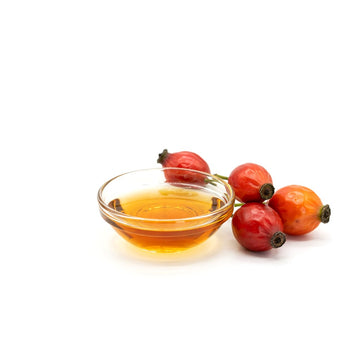
Rosehip oil is a dry-touch seed oil rich in essential fatty acids and natural carotenoids, valued for the look of softer scars, brighter, more even tone, and smoother texture. It absorbs fast and suits dry, uneven, and mature skin, and even feels light enough for many oily and combination complexions.
What rosehip oil does for your skin
Rosehip seed oil is cold-pressed from the small seeds inside the rosehip, and it is rich in essential fatty acids, chiefly linoleic and linolenic acid, along with natural carotenoids that carry a trace of provitamin A. In a controlled trial on post-surgical scars, twice-daily rosehip seed oil was linked with less redness and discoloration over twelve weeks than untreated skin, supporting its reputation for softer, more even-looking scars.[1] A 2024 review echoes that rosehip may help the look of scars and redness, while noting the evidence is still limited.[2] It absorbs quickly with a dry, non-greasy finish.
Rosehip oil for scars, tone, and texture
This is where rosehip has earned its name. Its fatty acids feed dry, depleted skin, while its carotenoids and trace of provitamin A support the look of renewal and more even tone. In the scar study above, daily use was tied to less visible redness and discoloration.[1] For old marks, uneven tone, and rough texture, it is one of the gentlest oils to reach for, night after night.
Is rosehip oil good for acne-prone skin?
Often, yes, which surprises people about a facial oil. Rosehip is high in linoleic acid, the lightweight, omega-6 fatty acid, and it absorbs with a dry finish rather than a greasy one, so many oily and combination complexions tolerate it well. It is not a treatment for active breakouts, but as a light nourishing oil it tends to sit comfortably where heavier oils feel like too much. If your skin is very reactive, start with a couple of nights a week.
How to use rosehip oil
Use it at night, as one of your last steps, after your water-based serums and before or instead of a heavier cream. Press three or four drops into the face and neck, or mix a drop into your moisturizer. Evenings suit it best, letting it nourish while you sleep.
Pairs easily with:
bakuchiol for gentle overnight renewal, hyaluronic acid underneath for hydration it can seal in, and vitamin C for brightness. Because it is an oil, it goes on after your water-based steps.
Is rosehip oil a natural retinol?
You will see rosehip called a natural retinol, so it is worth being clear. Rosehip carries only a trace of provitamin A from its carotenoids, not the true vitamin A that gives retinol its strength. It is a nourishing oil that gently supports the look of tone and texture, and a lovely thing to use, but it is not a stand-in for a retinoid. If gentle renewal is what you are after, bakuchiol is the plant active worth knowing, and our bakuchiol guide covers it.
Where we reach for rosehip
We use rosehip when skin needs feeding, not stripping. It sits at the heart of our Bakuchiol Overnight Oil, where it nourishes and supports the look of tone while bakuchiol does the gentle overnight renewal, the pairing we would choose over a harsh retinoid for dry, slow-aging skin. You will also find it softening the eye area in our Intensive Eye Balm. Cold-pressed, never synthetic, chosen for what it feeds back into the skin.
Shop the Bakuchiol Overnight OilA natural history
Rosehips are the jewel-red fruit left behind when a wild rose drops its petals, and the oil prized in skincare is cold-pressed from the small seeds inside. The most storied source is the wild rose the Spanish carried to South America, where it ran wild across the valleys of Chile, and the oil, rosa mosqueta, became a folk treasure for nourishing skin and softening the look of scars. Rosehips also carry one of the richest natural stores of vitamin C of any fruit.
That vitamin richness wrote rosehips into history. During the Second World War, when blockades cut Britain off from imported citrus, volunteers gathered hedgerow hips by the ton, which were boiled into a national rosehip syrup and handed out, especially to children, as a homegrown source of vitamin C. The same humble fruit became, in time, a beloved beauty oil.
References
[1] Valeron-Almazan P, et al. Evolution of post-surgical scars treated with pure rosehip seed oil. J Cosmet Dermatol Sci Appl. 2015;5(2):161-167. doi.org/10.4236/jcdsa.2015.52019
[2] Belkhelladi M, Bougrine A. Rosehip extract and wound healing: a review. J Cosmet Dermatol. 2024;23(1):62-67. doi.org/10.1111/jocd.15971
Found in these formulas
Questions, answered
It is a nourishing oil valued for the look of softer scars, more even tone, and comfortable, well-fed skin.
In a controlled study it was linked with less redness and discoloration in post-surgical scars, supporting a softer, more even look.
No. Rose oil comes from the petals; rosehip oil is pressed from the seeds inside the fruit.
Often, yes. It is high in lightweight linoleic acid and absorbs with a dry finish, so many oily and combination complexions tolerate it well.
Not really. It carries only a trace of provitamin A, not true vitamin A, so it nourishes and supports tone gently but is not a retinoid replacement.
At night works best, as one of your last steps, or mixed into your moisturizer.
The oil used in skincare is pressed from the seeds. The fruit is the source of the famous vitamin C, but the beauty oil comes from the seeds inside.