

Ingredient Library
Gotu Kola
Centella asiatica
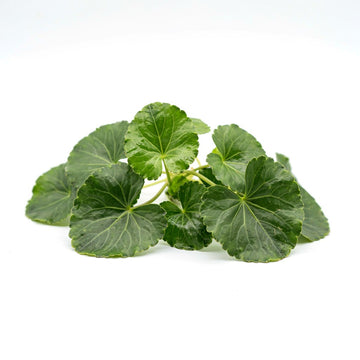
Gotu kola is a centuries-old Ayurvedic herb whose triterpene compounds are associated with the look of firmer, smoother skin and calmer redness. It suits mature, stressed, and sensitive skin, and you may know it by another name: centella, cica, or tiger grass.
What gotu kola does for your skin
Gotu kola's value to skin comes from a group of triterpene compounds: asiaticoside, madecassoside, and the asiatic and madecassic acids. A 2013 review in Advances in Dermatology and Allergology describes these compounds as supporting fibroblast activity and collagen, part of why the herb is associated with the look of firmer, smoother skin.[1] A 2021 review in Evidence-Based Complementary and Alternative Medicine summarizes laboratory and animal evidence that the same triterpenes help calm inflammatory responses in skin, consistent with its soothing reputation for the look of redness, though the authors note that larger clinical studies are still needed.[2]
Gotu kola, centella, and cica: the same plant, different names
If ingredient labels confuse you here, you are not alone. These are all the same botanical, named in different traditions:
| Name you will see | What it means |
|---|---|
| Gotu kola | The common English and Ayurvedic name for the herb, sometimes spelled gota kola |
| Centella asiatica | Its botanical name, the one used on an ingredient list |
| Cica | Short for centella, the name popularized by Korean skincare |
| Tiger grass | A folk nickname, from the old story of tigers rolling in it to heal |
| Madecassoside, asiaticoside | The purified active compounds drawn from the plant |
So if you have tried a cica cream or a tiger grass mask, you have already met gotu kola.
Gotu kola for firmness and stressed skin
Its two best-loved qualities work together. The triterpenes tied to fibroblast and collagen activity give it a firming, smoothing reputation, while the same compounds calm the look of redness.[1][2] That makes it a natural fit for skin that is at once mature and easily stressed, the skin that wants support without anything harsh.
How to use gotu kola
You will usually meet gotu kola in a serum or balm rather than on its own. It is gentle enough for morning or night and layers well under other steps. If your skin is very reactive, introduce it gradually, as you would any new active.
Pairs easily with:
niacinamide for barrier support, peptides for firmness, and hyaluronic acid for hydration. Its calming nature makes it an easy partner for most routines.
Why gotu kola leads our Body Firming Serum
When we wanted a serum to firm and smooth the look of the body, skin that is often drier and more neglected than the face, gotu kola was the obvious anchor. Its long reputation for supporting collagen and calming the skin is exactly what mature, stressed skin asks for, so we built our Gotu Kola Body Firming Serum around it. It also appears, quietly, in several of our eye and overnight treatments, wherever skin needs a little firming and a lot of calm.
Shop the Gotu Kola Body Firming SerumA natural history
Gotu kola is a low, creeping plant of Asia's wetlands that has been treasured for thousands of years across India and China, where it earned the name the herb of longevity. A favorite piece of folklore comes from Sri Lanka, where the plant was a known staple of elephants, and people linked its leaves to the elephant's long life and famously good memory. Whether or not the elephants would agree, the reputation stuck, and gotu kola became one of the most storied tonics in traditional Asian medicine.
Traditionally it was used in two main ways. It was laid on the skin as a poultice for wounds, burns, and stubborn troubles like ulcers and eczema, and it was brewed into a tea or eaten as a fresh green tonic believed to sharpen memory and steady a tired mind. In parts of Southeast Asia that cooling green drink is still made today.
References
[1] Bylka W, et al. Centella asiatica in cosmetology. Postepy Dermatol Alergol. 2013;30(1):46-49. doi.org/10.5114/pdia.2013.33378
[2] Park KS. Pharmacological effects of Centella asiatica on skin diseases. Evid Based Complement Alternat Med. 2021;2021:5462633. doi.org/10.1155/2021/5462633
Found in these formulas
Questions, answered
Its triterpene compounds are associated with the look of firmer, smoother skin and calmer redness, which is why it suits mature and stressed skin.
Yes. Gotu kola, centella asiatica, and cica are all the same plant. Cica is simply short for centella, popularized by Korean skincare.
Yes. It is linked with the look of firmer, smoother skin, which makes it a favorite for mature and stressed skin.
It is well tolerated by most skin and is often chosen to calm the look of redness. If your skin is very reactive, introduce it gradually.
Mandukaparni. It has been valued for centuries as a rejuvenating longevity herb.
It has a long traditional use on troubled skin, and its triterpenes are studied for soothing and supporting skin, consistent with a calmer, more even look.
It leads our Gotu Kola Body Firming Serum and appears in several of our eye and overnight treatments.