

Ingredient Library
Witch Hazel
Hamamelis virginiana
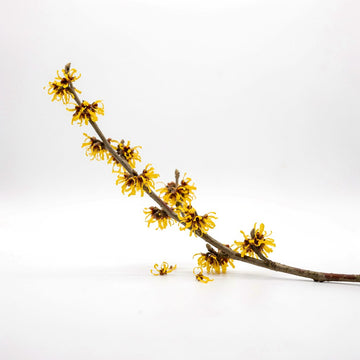
Witch hazel is a botanical astringent that tones, refreshes, and helps balance excess oil. We use a gentle, non-drying form that suits oily and combination skin.
A natural history
Witch hazel is native to the woodlands of eastern North America, and its use in skincare traces directly to Native American tradition, where a decoction of the boiled twigs and bark was applied to cuts, bruises, and irritated skin. That knowledge passed to European settlers and, by the mid-nineteenth century, became one of the first commercially distilled botanical skincare products, sold as the toning water still found on shelves today.
The curious name has nothing to do with witches. It comes from an old word, wych, meaning to bend, because the shrub's forked branches were favored as dowsing or divining rods, used to search for underground water. The plant kept its practical reputation into modern times: witch hazel is one of the few botanicals recognized by regulators as a skin astringent.
What it does for your skin
Witch hazel's character comes from its tannins, the astringent compounds behind its toning feel. In a study on volunteers, a witch hazel distillate helped calm the look of skin redness brought on by irritation.[1] And laboratory work on skin cells found that tannin-rich witch hazel extracts strongly scavenged free radicals and supported the skin's own antioxidant defenses.[2] That blend of gentle toning and antioxidant comfort is why it suits oily, congested skin.
References
[1] Korting HC, Schafer-Korting M, Hart H, Laux P, Schmid M. Anti-inflammatory activity of hamamelis distillate applied topically to the skin. Eur J Clin Pharmacol. 1993;44(4):315-318. doi.org/10.1007/BF00316465
[2] Wojciak M, Pacula W, Tyszczuk-Rotko K, et al. Comparative analysis of polyphenol-rich extracts from Hamamelis virginiana leaves and bark: ROS scavenging and anti-inflammatory effects on skin cells. Molecules. 2025;30(17):3572. doi.org/10.3390/molecules30173572
Found in these formulas
Questions, answered
It is a natural astringent that helps tone and refine the look of oily, congested skin while calming the look of redness.
Yes. Its toning tannins make it a classic choice for shiny, congested, and combination skin.
From an old word meaning to bend, because its forked branches were used as dowsing rods, not from anything to do with witches.
Our Firming and Brightening Eye Serum and Hair and Scalp Detox Rinse, among others.