

Ingredient Library
White Willow Bark
Salix alba
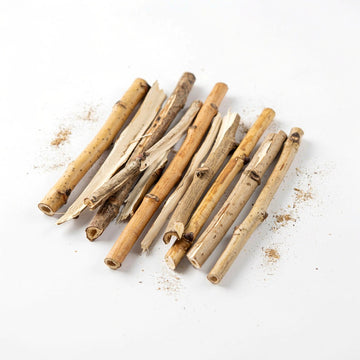
White willow bark is a natural source of salicylates that gently exfoliate and clarify pores. A botanical BHA, it suits oily, congested, and uneven skin.
A natural history
The willow has been a healing tree since the dawn of writing. Sumerian clay tablets and the ancient Egyptian Ebers papyrus both record willow leaves laid on inflamed, aching skin, and Hippocrates told his patients in ancient Greece to chew the bitter bark to ease pain and fever. For thousands of years, across many cultures, a strip of willow bark was a household remedy.
That long folk history hid a famous secret. In the early nineteenth century chemists isolated the active compound from willow and named it salicin, after Salix, the Latin word for willow. Salicin is the chemical ancestor of salicylic acid and, in turn, of aspirin, which Bayer launched in 1899. The same willow chemistry that became the world's most famous painkiller is what makes white willow bark a gentle, clarifying botanical in skincare.
What it does for your skin
White willow bark is a natural source of salicin, the precursor to salicylic acid, the beta hydroxy acid known for clarifying skin. In laboratory studies on human cells, standardized willow bark extract calmed markers of inflammation in a way broadly comparable to aspirin.[1] Other cell research found its soothing effect comes from a blend of compounds, not salicin alone.[2] In a formula it reads as a gentle, botanical way to support a clearer, smoother looking surface. Direct facial studies are limited.
References
[1] Le NPK, et al. Comparative anti-inflammatory effects of Salix cortex extracts and acetylsalicylic acid in SARS-CoV-2 peptide and LPS-activated human in vitro systems. Int J Mol Sci. 2021;22(13):6766. doi:10.3390/ijms22136766
[2] Bonaterra GA, et al. Anti-inflammatory effects of the willow bark extract STW 33-I in LPS-activated human monocytes and differentiated macrophages. Phytomedicine. 2010;17(14):1106-1113. doi:10.1016/j.phymed.2010.03.022
Questions, answered
It is a natural source of salicin, related to salicylic acid, used as a gentle botanical to support a clearer, smoother looking complexion.
It is milder. Its salicin content is modest, so it is best seen as a gentle clarifying botanical rather than a strong acid. People sensitive to aspirin should take care.