

Ingredient Library
Sea Buckthorn
Hippophae rhamnoides
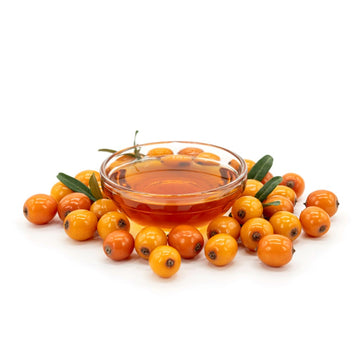
Sea buckthorn is a bright orange berry from a hardy thorned shrub, prized for an oil unusually rich in omega-7 and other fatty acids that soften, replenish, and support the skin barrier. In our line it leads the MMC Facial Oil. It suits dry, mature, and stressed skin.
Berry: Light, Dry
A natural history
Sea buckthorn has been valued for nearly two thousand years across the cold, high country of Tibet, Mongolia, and Central Asia, where the thorned shrub thrives in harsh soil that little else will tolerate. Its botanical name, Hippophae, comes from Greek words meaning shining horse, after the old observation that horses turned out to graze on it grew sleek and glossy of coat, a hint of the berry's nourishing richness. The 8th-century Tibetan medical classic the Djud-shi records hundreds of preparations made from it, and it was held in such esteem that it earned names like the holy fruit of the Himalayas.[1]
Traditionally the bright orange berry was put to use in more than one way. Its oil was pressed and smoothed onto the skin to soothe and help heal everything from burns to scrapes, and the tart, vitamin-rich fruit was eaten and brewed as a restorative tonic for strength and recovery in the demanding mountain climate where it grew.
What it does for your skin
Sea buckthorn's gift to skin is its fatty-acid profile. The fruit and seed oils together carry omega-3, 6, and 9, plus an unusually high level of omega-7 (palmitoleic acid), a lipid that closely mirrors the oils skin makes itself, which is part of why it feels so at home on dry and mature skin.[2]
A 2017 review in Lipids in Health and Disease credits that balance of fatty acids, together with sea buckthorn's natural carotenoids and vitamins, with softening, replenishing, and supporting the skin barrier, which is why the oil is so prized for dry, flaky, and tired-looking skin.[2] Laboratory and animal research has also reported anti-inflammatory activity on irritated, sensitive skin, though that is early evidence rather than proof of a treatment.[3]
References
[1] On the historical use of sea buckthorn in Tibetan and Mongolian traditional medicine, including the 8th-century Tibetan medical text the Djud-shi (Yuthog Yontan Gonpo).
[2] Zielinska A, Nowak I. Abundance of active ingredients in sea-buckthorn oil. Lipids Health Dis. 2017;16(1):95. doi.org/10.1186/s12944-017-0469-7
[3] Hou DD, et al. Sea Buckthorn (Hippophae rhamnoides L.) Oil Improves Atopic Dermatitis-Like Skin Lesions. Skin Pharmacol Physiol. 2017;30(5):268-276. doi.org/10.1159/000479528
Found in these formulas
Questions, answered
It is one of the richest known plant sources of omega-7 (palmitoleic acid), a fatty acid that mirrors the skin's own oils, alongside omega-3, 6, and 9. That combination is why it feels so nourishing on dry and mature skin.
Yes. Its fatty acids help soften skin and support the moisture barrier, which is why it is so prized for dry, flaky, and tired-looking skin.
The deep color is natural, from the berry's carotenoids and antioxidants. Blended into a facial oil it lends a warm tint without staining.
Dry, mature, and depleted skin benefit most, though its barrier support makes it a comfortable choice for nearly every skin type.