

Ingredient Library
Prickly Pear
Opuntia ficus-indica
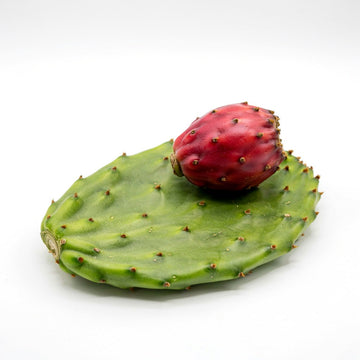
Prickly pear seed oil is a rare desert oil exceptionally rich in vitamin E and linoleic acid that brighten and firm. Light and restorative, it suits dull, mature skin.
A natural history
The prickly pear is a cactus native to Mexico, where it is known as the nopal and has been food, drink, and medicine since long before the Spanish arrived. It carries deep meaning: the eagle perched on a prickly pear cactus, devouring a serpent, is the emblem at the center of the Mexican flag, rooted in the Aztec founding legend of Tenochtitlan. The flat pads also host the tiny cochineal insect, source of a brilliant red dye once prized across the world.
Carried by ship after Columbus, the hardy cactus spread around the Mediterranean and North Africa, where it now grows wild on sun baked hillsides. The fruit is sweet and jewel colored, but it is the tiny seeds inside, each yielding only a trace of oil, that the cosmetic world prizes. A true desert survivor, the plant stores so much water in its pads that they are roughly four fifths water.
What it does for your skin
Prickly pear seed oil is remarkably rich in antioxidant vitamin E and in skin conditioning linoleic acid. Analyses of cold pressed cactus seed oil confirm a high tocopherol content, mostly gamma tocopherol, along with phenolic antioxidants and free radical scavenging activity.[1] A separate study found the oil over eighty percent unsaturated, dominated by linoleic acid, with strong antioxidant capacity in testing.[2] In a formula it is a light, vitamin E rich oil that helps skin look conditioned and defended. The skin specific data is mostly compositional.
References
[1] Nounah I, et al. Effect of seed's geographical origin on cactus oil physico-chemical characteristics, oxidative stability, and antioxidant activity. Food Chem X. 2024;22:101445. doi:10.1016/j.fochx.2024.101445
[2] Berraaouan A, et al. Chemical composition of cactus pear seed oil: phenolics identification and antioxidant activity. J Pharmacopuncture. 2022;25(2):121-129. doi:10.3831/KPI.2022.25.2.121
Found in these formulas
Questions, answered
It is exceptionally rich in antioxidant vitamin E and linoleic acid, which help skin look conditioned, replenished, and defended.
No. It is a notably light, fast-absorbing oil, which is part of why it is so prized.