

Ingredient Library
Manjistha
Rubia cordifolia
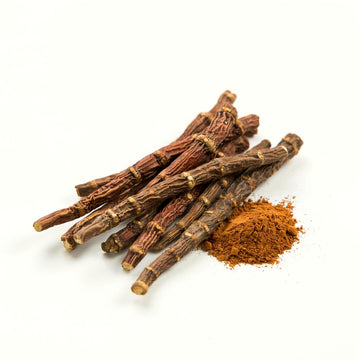
Manjistha is an Ayurvedic root traditionally used to brighten and clarify. It helps even tone and revive a dull complexion, and suits uneven or congested skin.
A natural history
Manjistha is a climbing plant of India and the Himalayas with striking crimson roots, and it has lived a double life for thousands of years: as a medicine and as a dye. As a member of the madder family, its root yields a brilliant, lasting red, and traces of that very pigment have been found in cloth from the ancient Indus Valley city of Mohenjo-daro and on textiles in the tomb of the pharaoh Tutankhamun. The same red compounds that colored those ancient cloths are the ones studied today for their antioxidant activity.
In the Indian tradition manjistha was prized above all as a skin and complexion herb. It was classed among the botanicals used to support an even, clear complexion, and a paste of the root was a classic preparation smoothed onto the face for the look of brightness and tone, as well as among the herbs valued for helping skin recover.
What it does for your skin
Manjistha's red root is rich in antioxidant compounds called anthraquinones. One of the main ones, purpurin, was shown in cell studies to switch on the skin's own antioxidant-defense pathway, the kind of action associated with skin that looks defended against everyday stress.[1] Analysis of the root confirms it is dense with these antioxidant compounds and raises antioxidant markers in further studies.[2] Modern skin-specific testing is still limited, so we lean on manjistha's antioxidant richness and its long traditional use for the look of even, clear skin.
References
[1] Ren Q, Bakker W, Wesseling S, et al. On the role of ROS and glutathione in the mode of action underlying Nrf2 activation by the hydroxyanthraquinone purpurin. Antioxidants (Basel). 2023;12(8):1544. doi.org/10.3390/antiox12081544
[2] Prabhakara S, Anbazhagan K, Chandrashekar BS, et al. Characterization of Rubia cordifolia L. root extract and its evaluation of cardioprotective effect in Wistar rat model. Indian J Pharmacol. 2018;50(1):12-21. doi.org/10.4103/ijp.IJP_418_17
Found in these formulas
Questions, answered
It is one of the classic Ayurvedic complexion herbs, valued for the look of clearer, more even skin, and it is rich in antioxidants.
Yes. Its red root is part of the madder family and has colored cloth for thousands of years, including textiles found at Mohenjo-daro and in Tutankhamun's tomb.
Skin-specific studies are still limited, so we describe it honestly, by its antioxidant compounds and its long traditional use for complexion.
Our Intensive Eye Balm and Overnight Eye Treatment, among others.