

Ingredient Library
Licorice Root
Glycyrrhiza glabra
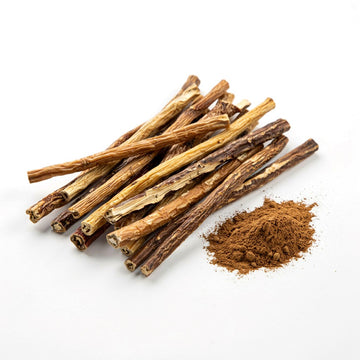
Licorice root is a botanical brightener whose glabridin helps fade the look of dark spots and even tone while calming redness. It suits dull, uneven, or sensitive skin.
A natural history
Licorice root is one of the oldest remedies known, and few plants leave a more vivid trail through history. Bundles of the root were placed among the treasures of Tutankhamun's tomb more than three thousand years ago, sent with the young pharaoh so he could keep making his favorite sweet drink in the afterlife. Ancient Greek writers called it the Scythian root, and it marched with armies: soldiers were told to chew licorice on long campaigns to quench their thirst and hold their stamina when water ran short.
Across those cultures the root was put to similar use. It was chewed or brewed to soothe the throat and quiet a cough, and it was prized as a gentle, sweet remedy that softened and comforted, including when smoothed onto the skin. In traditional Chinese medicine it became one of the most widely used herbs of all, the quiet harmonizer folded into countless formulas.
What it does for your skin
Licorice owes much of its brightening reputation to glabridin, a compound concentrated in the root. In laboratory and animal studies, glabridin was shown to inhibit tyrosinase, a key enzyme in pigment formation, and to reduce UV-induced pigmentation and redness.[1] A 2011 review in the Journal of the European Academy of Dermatology and Venereology groups licorice among the botanicals used to support a brighter, more even-looking tone, while noting the cosmetic evidence base is still building.[2] Gently softening the look of dark spots while calming the look of redness is why licorice pairs so naturally with vitamin C.
References
[1] Yokota T, Nishio H, Kubota Y, Mizoguchi M. The inhibitory effect of glabridin from licorice extracts on melanogenesis and inflammation. Pigment Cell Res. 1998;11(6):355-361. doi.org/10.1111/j.1600-0749.1998.tb00494.x
[2] Leyden JJ, Shergill B, Micali G, Downie J, Wallo W. Natural options for the management of hyperpigmentation. J Eur Acad Dermatol Venereol. 2011;25(10):1140-1145. doi.org/10.1111/j.1468-3083.2011.04130.x
Found in these formulas
Questions, answered
Yes. Its compound glabridin interrupts pigment formation, which is why licorice is valued for a brighter, more even-looking tone.
It is. It is traditionally used to calm the look of redness, making it gentle on easily reddened skin.
Beautifully. Licorice is a gentle brightener that complements vitamin C.
Yashtimadhu, a sweet, cooling, complexion-supporting root.