

Ingredient Library
Hibiscus
Hibiscus sabdariffa
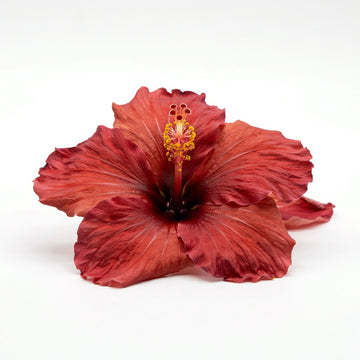
Hibiscus is rich in plant acids and antioxidants that gently exfoliate and support firmness. It smooths and brightens, and suits dull or aging skin.
A natural history
Hibiscus, in the roselle form used here, traces back to Africa, where its deep-red calyces have been steeped into tart, ruby drinks for many centuries. Carried across the world by trade, it became a beloved beverage under many names: karkade in Egypt and Sudan, agua de Jamaica in Mexico, sorrel in the Caribbean, and bissap in West Africa. The same anthocyanin pigments that give those drinks their jewel-red color are the antioxidants prized in skincare.
Beyond the cup, hibiscus has a long folk life in beauty, especially for hair and skin, where flower infusions were used to condition and refresh. In the modern beauty press it picked up the nickname nature's botox, a marketing turn of phrase rather than a medical claim, pointing to its naturally occurring fruit acids and its smoothing, brightening reputation.
What it does for your skin
Hibiscus is rich in antioxidant anthocyanins and naturally occurring fruit acids. A 2022 laboratory study in Molecules found that hibiscus extracts and a compound called hibiscus acid supported skin cells in building the matrix that keeps skin looking firm, along with antioxidant activity against stress.[1] Chemical analysis confirms that roselle is dense with antioxidant anthocyanins, the pigments behind its color and much of its appeal.[2] These are laboratory findings, so we describe hibiscus by its antioxidant richness and gentle, smoothing nature rather than any single promise.
References
[1] Wang D, Nagata M, Matsumoto M, et al. Potential of Hibiscus sabdariffa L. and hibiscus acid to reverse skin aging. Molecules. 2022;27(18):6076. doi.org/10.3390/molecules27186076
[2] Sindi HA, Marshall LJ, Morgan MRA. Comparative chemical and biochemical analysis of extracts of Hibiscus sabdariffa. Food Chem. 2014;164:23-29. doi.org/10.1016/j.foodchem.2014.04.097
Found in these formulas
Questions, answered
It is a beauty-world nickname, not a medical claim. It points to hibiscus's naturally occurring fruit acids and its smoothing, brightening reputation.
Its antioxidant anthocyanins and gentle fruit acids help smooth and brighten the look of dull, tired skin.
Yes. It is traditionally considered light, dry, and cooling, which suits warm, congested, or tired-looking skin.
Our Hair and Scalp Treatment Serum and 72 Herbs Muscle and Joint Relief Balm.