

Ingredient Library
Gokshura
Tribulus terrestris
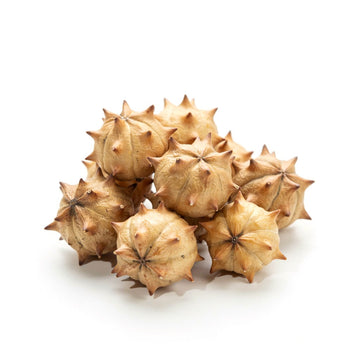
Gokshura is an Ayurvedic botanical traditionally used to firm and revitalize. Supporting a healthier-looking complexion, it suits dull and mature skin.
A natural history
Gokshura is one of the most treasured plants of Ayurveda, gathered for thousands of years across the warm, dry lands of India and beyond. It grows low to the ground in poor, sun baked soils, and for all its humble appearance it has long been honored as a rasayana, a rejuvenating tonic meant to restore strength and vitality.
There is poetry even in its name. Gokshura comes from the Sanskrit for cow's hoof, a nod to the shape of its small, sharp, spiny fruit, which earned the plant its English name of puncture vine. Tucked into that little fruit is the antioxidant character that brings it into modern skin care.
What it does for your skin
Gokshura is an antioxidant rich botanical with deep roots in Ayurvedic tradition. Reviews of the plant document that its fruit carries antioxidant compounds, flavonoids, phenolic acids, and saponins, the kind of plant chemistry that helps defend the look of skin against everyday stress.[1] In laboratory testing, gokshura extract showed measurable free radical scavenging activity tied to its phenolic content.[2] In a formula it is a toning, revitalizing botanical for dull or stressed looking skin. Its skin specific evidence is limited, so we lean on its antioxidant character and its heritage.
References
[1] Stefanescu R, et al. A comprehensive review of the phytochemical, pharmacological, and toxicological properties of Tribulus terrestris L. Biomolecules. 2020;10(5):752. doi:10.3390/biom10050752
[2] Malik MY, et al. Evaluation of the phytochemical screening of methanolic seed extracts of Tribulus terrestris: an in vitro application of anti-cancer, anti-oxidant, and anti-microbial activities. Cureus. 2024;16(8):e66674. doi:10.7759/cureus.66674
Found in these formulas
Questions, answered
It is an antioxidant-rich Ayurvedic botanical used to help defend, tone, and revitalize the look of dull or stressed skin.
It comes from the Sanskrit for cow's hoof, after the shape of its small spiny fruit, which also gives the plant its English name, puncture vine.