

Ingredient Library
Fir, Pine & Spruce
Abies sibirica (fir); Pinus sylvestris (pine); Picea mariana (spruce)
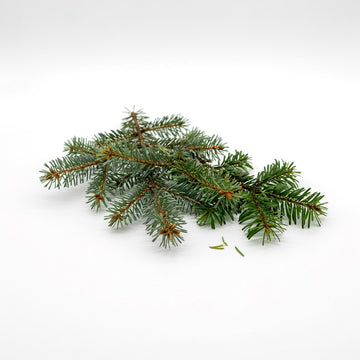
Fir, pine, and spruce are crisp evergreen oils that refresh and clarify skin and senses. Invigorating, they suit oily skin and grounding balm formulas.
A natural history
Fir, pine, and spruce are three different evergreens, the great conifers of the northern forests, each with its own character. Their fresh, resinous scent comes from airborne compounds the trees release, the very essence of a walk in the woods, and the heart of the Japanese practice of forest bathing, shinrin yoku, long associated with calm and wellbeing.
These trees have sustained people for ages. Conifer needles are rich in vitamin C, and a needle tea brewed by Indigenous peoples of the Saint Lawrence famously saved Jacques Cartier's scurvy stricken crew through the bitter winter of 1536. Evergreen and unbowed by winter, fir, pine, and spruce have always stood for endurance and renewal.
What it does for your skin
Three distinct conifers, each a fresh, clarifying needle oil rich in pine like compounds. Fir (Abies) needle oil showed antioxidant and antibacterial activity in laboratory testing.[1] Pine (Pinus sylvestris) needle oil, pinene rich, showed antibacterial activity against skin relevant bacteria.[2] Spruce (Picea) needle oil rounds out the trio with its own antioxidant, antimicrobial character.[3] Together in a formula, used gently, they lend a clarifying, refreshing, forest fresh touch to dull or oily looking skin. Their clarifying, refreshing character is documented in laboratory antioxidant and antibacterial studies.
References
[1] Zubaid-Ul-Khazir, et al. Gas chromatographic-mass spectrometric analysis, antibacterial, antioxidant and antiproliferative activities of the needle essential oil of Abies pindrow growing wild in Kashmir, India. Microb Pathog. 2021;158:105013. doi:10.1016/j.micpath.2021.105013
[2] Galgano M, et al. Antimicrobial activity of essential oils evaluated in vitro against Escherichia coli and Staphylococcus aureus. Antibiotics (Basel). 2022;11(7):979. doi:10.3390/antibiotics11070979
[3] Garzoli S, et al. Liquid and vapor phase of four conifer-derived essential oils: comparison of chemical compositions and antimicrobial and antioxidant properties. Pharmaceuticals (Basel). 2021;14(2):134. doi:10.3390/ph14020134
Found in these formulas
Questions, answered
No, they are three different evergreen trees (Abies, Pinus, and Picea). Each gives its own fresh, clarifying needle oil, and together they capture the scent of the forest.
Their pinene-rich needle oils are clarifying and antioxidant, used in gentle measure to lend a fresh, refreshing touch to dull or oily-looking skin.