

Ingredient Library
Evening Primrose Oil
Oenothera biennis
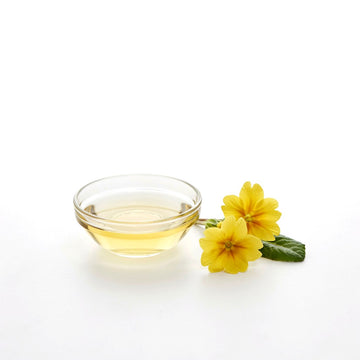
Evening primrose oil is rich in GLA, an omega-6 that calms and rebalances skin prone to dryness or hormonal flare-ups. Soothing, it suits dry, reactive skin.
A natural history
Evening primrose is a North American wildflower that Native American peoples used as a healing plant, pounding its roots into warm poultices laid on bruises and irritated skin and brewing the leaves as a remedy. Its pale flowers keep to a quiet schedule, staying shut by day and springing open at dusk, which is how it earned its name.
When the plant reached Europe it gathered such a reputation as a cure that it was nicknamed the king's cure-all. Modern skin care looks past the flower to the seed, which is one of the richest plant sources of gamma linolenic acid, a rare essential fatty acid that is a genuine building block of the skin's own moisture barrier.
What it does for your skin
Evening primrose oil is one of the better plant sources of gamma linolenic acid, an essential fatty acid that is part of the skin's lipid barrier. In a vehicle controlled study, topical evening primrose oil helped stabilize the skin's barrier, though the benefit depended on the formula it was carried in.[1] It is worth being honest about the limits: a large review found that taking evening primrose oil by mouth did not meaningfully improve eczema, so it is best understood as a barrier conditioning oil rather than a treatment.[2] In a formula it softens and conditions dry skin.
References
[1] Gehring W, et al. Effect of topically applied evening primrose oil on epidermal barrier function in atopic dermatitis as a function of vehicle. Arzneimittelforschung. 1999;49(7):635-642. doi:10.1055/s-0031-1300475
[2] Bamford JTM, et al. Oral evening primrose oil and borage oil for eczema. Cochrane Database Syst Rev. 2013;(4):CD004416. doi:10.1002/14651858.CD004416.pub2
Found in these formulas
Questions, answered
It is rich in the essential fatty acid GLA, a building block of the skin barrier, and is used as a conditioning oil that helps soften dry skin.
No. A large review found that taking it by mouth did not meaningfully help eczema, so it is best seen as a barrier-friendly emollient, not a treatment.