

Ingredient Library
Elemi
Canarium luzonicum
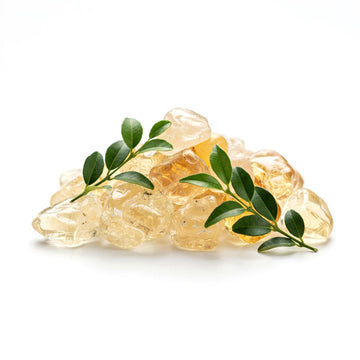
Elemi is a resin oil in the frankincense family traditionally used to revive and smooth mature skin. Restorative, it suits aging or dull skin.
A natural history
Elemi is the fragrant, pale golden resin of a tall evergreen tree of the Philippines, its steam distilled oil carrying a fresh, lemony, piney scent with a soft frankincense like warmth. Indeed, elemi belongs to the very same botanical family as frankincense and myrrh, the great aromatic resins of antiquity, and has long been called the poor man's frankincense for its accessible, kindred beauty.
For generations elemi has been valued as a skin friendly resin, folded into salves and balms and prized in perfumery as a fixative. Its name traces back through old apothecary usage to a Greek word for a wound soothing preparation, a fitting heritage for a resin so long associated with the care of mature and weathered skin.
What it does for your skin
Elemi is a soothing, resinous oil rich in fresh terpenes. In laboratory study, elemi oil was found rich in limonene and elemol and showed antioxidant, free radical scavenging activity.[1] Further analysis of this frankincense family resin confirmed its limonene rich, antimicrobial character.[2] In a formula, used in gentle measure, elemi lends a soothing, conditioning, lightly defending touch to mature or weathered looking skin. That soothing, lightly defending character is documented in laboratory antioxidant studies of its limonene.
References
[1] Galovicova L, et al. Essential oils and their application in a food model. Potravinarstvo Slovak J Food Sci. 2020;14:1088-1096. doi:10.5219/1490
[2] Nikolic M, et al. Sensitivity of clinical isolates of Candida to essential oils from Burseraceae family. EXCLI J. 2016;15:280-289. doi:10.17179/excli2014-621
Found in these formulas
Questions, answered
It is a soothing, antioxidant resin oil, a botanical cousin of frankincense, used in gentle measure to condition and comfort mature or weathered-looking skin.
It belongs to the same botanical family as frankincense and myrrh and shares a similar warm, resinous aroma, in a more accessible form.