

Ingredient Library
Cupuacu Butter
Theobroma grandiflorum
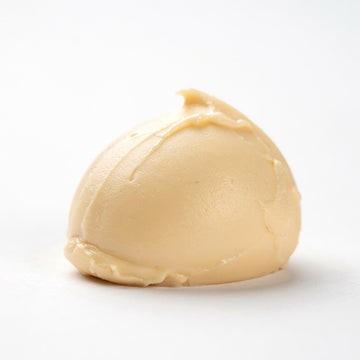
Cupuacu butter is an Amazonian butter that holds many times its weight in water, deeply softening and replenishing. Rich and restorative, it suits very dry, mature skin.
A natural history
Cupuacu is a fruit of the Amazon rainforest, beloved across northern Brazil, and it grows on a close cousin of the cacao tree. The two share the genus Theobroma, a name the botanist Linnaeus built from Greek words meaning food of the gods. The white pulp inside the heavy fruit tastes like a cross between chocolate and pineapple and flavors juices, ices, and sweets throughout the region.
The seeds hold the prize for skin. Pressed into a soft, ivory butter, they yield cupuacu butter, rich and slow to melt until it meets the warmth of skin. The same seeds can even be made into a chocolate like treat the Brazilians call cupulate. A true Amazonian superfruit, cupuacu has moved from rainforest markets to the world's moisturizers.
What it does for your skin
Cupuacu butter is a rich emollient whose fats melt close to skin temperature, giving it a cushioning, conditioning feel. Studies of the butter confirm a fat that softens and melts on contact with skin, the physical basis of a deeply emollient, protective finish.[1] Further analysis details its balance of stearic and oleic fatty acids, the profile behind its buttery, barrier feel.[2] In a formula it is a luxurious, softening butter that helps dry, thirsty looking skin feel cushioned and conditioned.
References
[1] Silva JC, et al. Polymorphic phases of natural fat from cupuassu (Theobroma grandiflorum) beans: a WAXS/SAXS/DSC study. Cryst Growth Des. 2009;9(12):5155-5163. doi:10.1021/cg901081j
[2] Rodriguez-Negrette AC, et al. Dry fractionation of cupuassu (Theobroma grandiflorum) fat: physical-chemical properties and polymorphic behavior. J Am Oil Chem Soc. 2020;97(11):1215-1228. doi:10.1002/aocs.12418
Found in these formulas
Questions, answered
It is a rich, cushioning plant butter that melts into skin to soften and condition dry, rough, thirsty-looking skin.
It grows on a close cousin of the cacao tree, in the same genus Theobroma, and its seeds can even be made into a chocolate-like treat.