

Ingredient Library
Cogon Grass
Imperata cylindrica
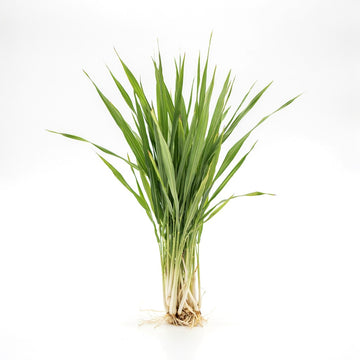
Cogon grass is a resilient plant rich in potassium that draws in and holds deep moisture. Hydrating, it suits dry and dehydrated skin.
A natural history
Cogon grass is one of the toughest plants on earth, a hardy grass that thrives across the warm, dry, sun scorched corners of Asia, Africa, and beyond. Where gentler plants fail, it endures, surviving drought by drawing back into a deep network of roots that quietly conserve water until the rains return.
That very gift for managing water is what carried this humble grass into skin care. The root, rich in minerals and water loving compounds, is prized as a hydrator, and there is a lovely symmetry to it: a plant that survives the driest ground is used to help thirsty skin hold onto its own moisture.
What it does for your skin
Cogon grass root is valued as a moisture binding hydrator. Research on the plant documents that it is rich in minerals and water soluble compounds, including polysaccharides shown to carry antioxidant activity in testing.[1] Further study of these root polysaccharides confirmed a notable free radical scavenging capacity.[2] In a formula, cogon grass root acts as a replenishing hydrator that helps dry, thirsty looking skin feel soft, cushioned, and comfortable. Its hydrating reputation rests largely on this mineral and polysaccharide content.
References
[1] Jung YK, Shin D. Imperata cylindrica: a review of phytochemistry, pharmacology, and industrial applications. Molecules. 2021;26(5):1454. doi:10.3390/molecules26051454
[2] Yu W, et al. Optimization of ultrasound-assisted extraction of Imperata cylindrica polysaccharides and evaluation of its anti-oxidant and amelioration of uric acid stimulated cell apoptosis. Ultrason Sonochem. 2024;104:106844. doi:10.1016/j.ultsonch.2024.106844
Found in these formulas
Questions, answered
Its mineral- and polysaccharide-rich root is used as a moisture-binding hydrator, helping dry, thirsty-looking skin feel soft and cushioned.
This grass survives drought by conserving water in its roots, and that same water-loving root is prized to help skin hold onto its own moisture.