

Ingredient Library
Cardamom
Elettaria cardamomum
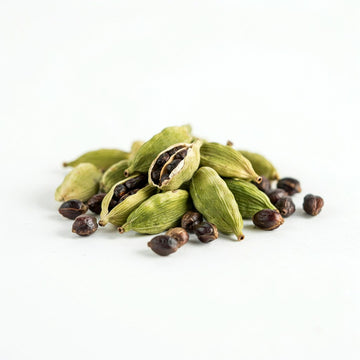
Cardamom is a warming spice whose oil tones and refreshes while lending a soft aromatic lift. Balancing and uplifting, it suits dull or tired skin.
A natural history
Cardamom grows wild in the misty evergreen forests of the Western Ghats in southern India, a range so thick with it that part of it is simply called the Cardamom Hills. It is one of the oldest and most valuable spices on earth, hand harvested pod by pod at the exact moment of ripeness to protect the fragrant oils inside. The ancient Greeks and Romans imported it to scent their perfumes and aromatic oils.
The little green pods became a thread of trade and ritual across the ancient world. In the Arab world cardamom is the soul of gahwa, the cardamom coffee poured as a gesture of welcome, a custom that runs back centuries. By weight it ranks among the most precious spices in the world, behind only saffron and vanilla, which is how it earned its enduring title, the queen of spices.
What it does for your skin
Cardamom seed is full of aromatic antioxidant compounds, among them cineole and the flavonoids quercetin and kaempferol.[1] A critical review of the spice documents its antioxidant activity in laboratory testing and its long use in fragrance, the qualities it lends to skincare.[2] Direct studies on skin are limited, so in a formula cardamom is best understood as a warming aromatic, antioxidant rich botanical that gives a lively, refreshed character.
References
[1] Masoumi-Ardakani Y, et al. Chemical composition, anticonvulsant activity, and toxicity of essential oil and methanolic extract of Elettaria cardamomum. Planta Med. 2016;82(17):1482-1486. doi:10.1055/s-0042-106971
[2] Ashokkumar K, et al. Botany, traditional uses, phytochemistry and biological activities of cardamom. J Ethnopharmacol. 2019;246:112244. doi:10.1016/j.jep.2019.112244
Found in these formulas
Questions, answered
It is an aromatic, antioxidant-rich seed that lends a refreshed, enlivened character. Direct skin studies are limited, so it is used as a botanical accent.
It is among the most prized and costly spices in the world, valued for its fragrance and careful hand harvesting.