

Ingredient Library
Blue Green Algae
Arthrospira platensis
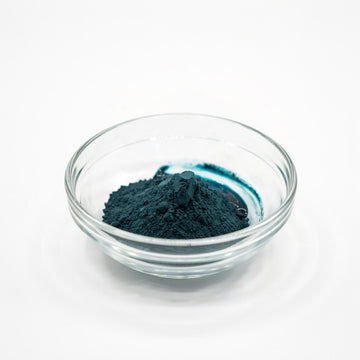
Blue green algae is a nutrient-dense water plant rich in amino acids, vitamins, and minerals that nourish and support firmness. Revitalizing, it suits dull, mature skin.
Find it in
A natural history
Blue green algae, best known as spirulina, is one of the oldest forms of life on earth, a tiny spiral of blue green that flourishes in warm, mineral rich lakes. Five centuries ago the Aztecs skimmed it from the surface of Lake Texcoco and dried it into nourishing cakes sold in their markets, an early superfood that helped feed a civilization.
That ancient little algae has traveled a remarkable road. So concentrated in protein, vitamins, and minerals is spirulina that NASA has carried it as a nutritious food for astronauts in space. The same brilliant pigment that gives it its blue green color, phycocyanin, turns out to be a powerful antioxidant, which is exactly what brought this venerable superfood from the lake to the serum.
What it does for your skin
Blue green algae is rich in antioxidants, led by its vivid blue pigment phycocyanin. In laboratory testing, phycocyanin was the most abundant compound in spirulina and showed strong free radical scavenging activity, more than its carotenoid pigments.[1] A scientific review concludes that spirulina activates the body's antioxidant defenses and scavenges free radicals, crediting phycocyanin and beta carotene.[2] In a formula it is an antioxidant and mineral rich extract that helps dull, tired skin look revitalized and defended. Its skin research is largely laboratory based.
References
[1] Park WS, et al. Two classes of pigments, carotenoids and C-phycocyanin, in spirulina powder and their antioxidant activities. Molecules. 2018;23(8):2065. doi:10.3390/molecules23082065
[2] Wu Q, et al. The antioxidant, immunomodulatory, and anti-inflammatory activities of spirulina: an overview. Arch Toxicol. 2016;90(8):1817-1840. doi:10.1007/s00204-016-1744-5
Questions, answered
It is an antioxidant- and mineral-rich algae, led by the blue pigment phycocyanin, used to help dull, tired skin look revitalized and defended.
Yes. It is one of earth's oldest life forms, eaten by the Aztecs five centuries ago and now nutritious enough to feed astronauts.