

Ingredient Library
Amla
Phyllanthus emblica
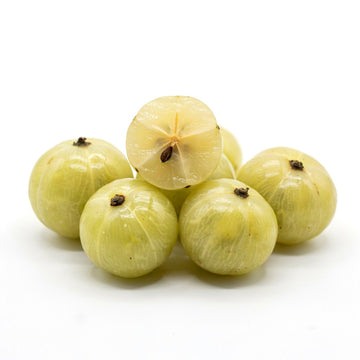
Amla, or Indian gooseberry, is one of nature's richest sources of stable vitamin C. It brightens, supports firmness, and defends against daily stress. It suits dull, aging skin.
A natural history
Amla, the Indian gooseberry, has been prized in India for well over a thousand years, and one fact still sets it apart: it is among the richest natural sources of vitamin C, holding many times what an orange carries, and unusually, that vitamin C stays remarkably stable even after the fruit is dried. Its place in legend is just as memorable. The famous rejuvenating tonic Chyavanaprasha takes its name from the sage Chyavana who, as the story goes, was old and frail until a healing preparation built around amla restored his youth and vigor.
That reputation made amla a cornerstone of traditional tonics. It is one of the three fruits in the classic Triphala blend, and it was eaten as a rejuvenating preserve to support lasting vitality. It also has a long life in beauty care: in Kerala, amla has traditionally been steeped in warm coconut oil to make a hair oil still loved today for strong, glossy, dark hair.
What it does for your skin
Amla's strength is its antioxidant density, carried by its natural vitamin C and polyphenols. In a 2010 study in the Journal of Ethnopharmacology, an Emblica officinalis fruit extract helped protect skin cells' procollagen and reduced UV-induced breakdown of collagen, an antioxidant action linked to firmer, more protected-looking skin.[1] A 2016 comparison in Pharmaceutical Biology found amla fruit extract had the highest polyphenol content and the strongest free-radical-scavenging activity of the botanicals tested, with measurable anti-collagenase activity.[2] These are laboratory findings, but they help explain why amla is so valued for brighter, more resilient-looking skin.
References
[1] Adil MD, Kaiser P, Satti NK, Zargar AM, Vishwakarma RA, Tasduq SA. Effect of Emblica officinalis (fruit) against UVB-induced photo-aging in human skin fibroblasts. J Ethnopharmacol. 2010;132(1):109-114. doi.org/10.1016/j.jep.2010.07.047
[2] Pientaweeratch S, Panapisal V, Tansirikongkol A. Antioxidant, anti-collagenase and anti-elastase activities of Phyllanthus emblica, Manilkara zapota and silymarin. Pharm Biol. 2016;54(9):1865-1872. doi.org/10.3109/13880209.2015.1133658
Found in these formulas
Questions, answered
It is one of the most antioxidant-dense fruits known, rich in natural vitamin C, which helps defend skin against the look of environmental stress.
Yes. Its fruit is naturally high in vitamin C, part of why it complements vitamin C serums.
Amalaki, revered as a rasayana, or rejuvenating fruit, and one of the three fruits of Triphala.
Dull, stressed, and mature skin that could use brightening and antioxidant support.